
I have long studied meteors; see some of my work on the topic here. Nowadays modern digital equipment has eliminated what was once the last bastion of visual astronomy. But there remains one tiny field where little professional work has been done: telescopic meteors. This is such an obscure topic that even Wikipedia lacks a page devoted to it. Here’s what is probably the best resource on the Internet about telescopic meteors. These are meteors that are so small and faint that they are invisible to the naked eye. In times past, astronomers would occasionally note that they saw a meteor flash through the field of view they were viewing. But we’ve never had a good instrument for catching telescopic meteors.
Until now. Behold!
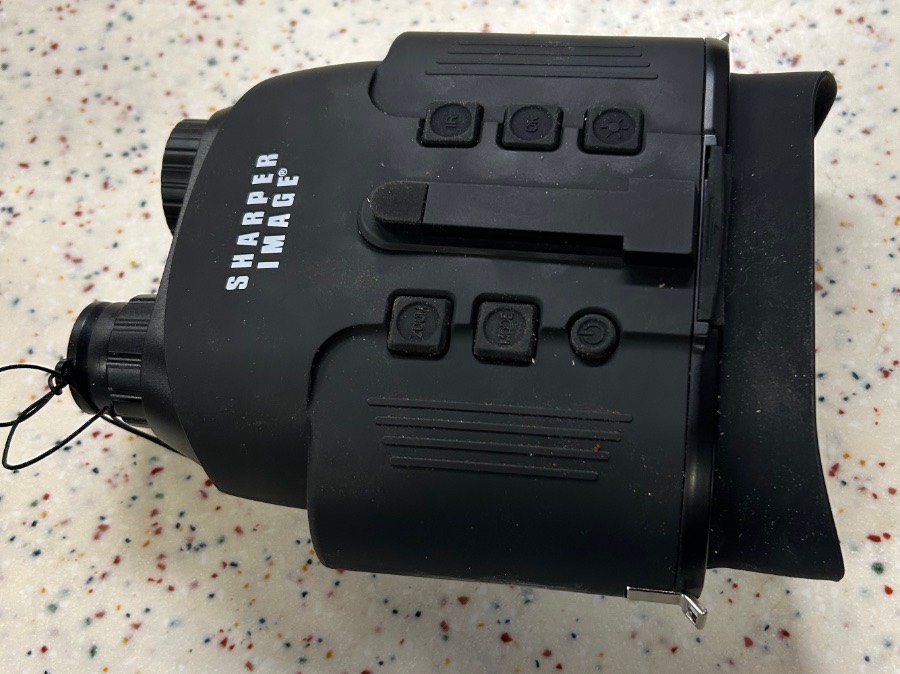
This, surprisingly, is an ideal camera for recording telescopic meteors. It is sold as a night vision instrument, primarily for hunters or people who want to see critters in the dark. It uses a Sony chip that is especially sensitive to infrared light, and the result is impressive:
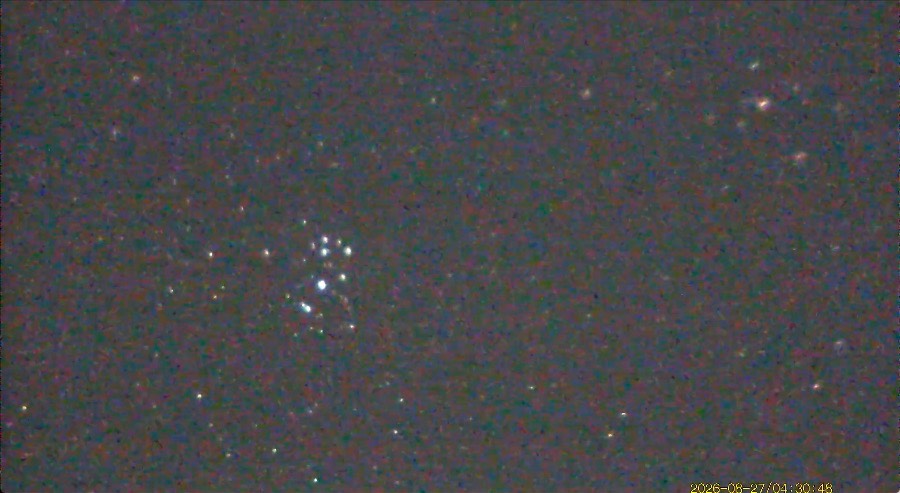
This image is 900 pixels wide by 493 pixels high; the original is 1920 wide by 1020 high. Careful study shows that it detects stars down to 8th magnitude; that’s VERY impressive!
I originally bought another brand camera with a slightly different layout that was, I figured, better suited to use in astronomy, but it refused to remain focused, so I bought the Sharper Image camera because that is what my friend Dave Walker was using, and it was producing excellent results.
I eventually figured out that the focussing problem arose when the camera was vertical, so I build a special cradle with a right-angle prism to fix the problem:
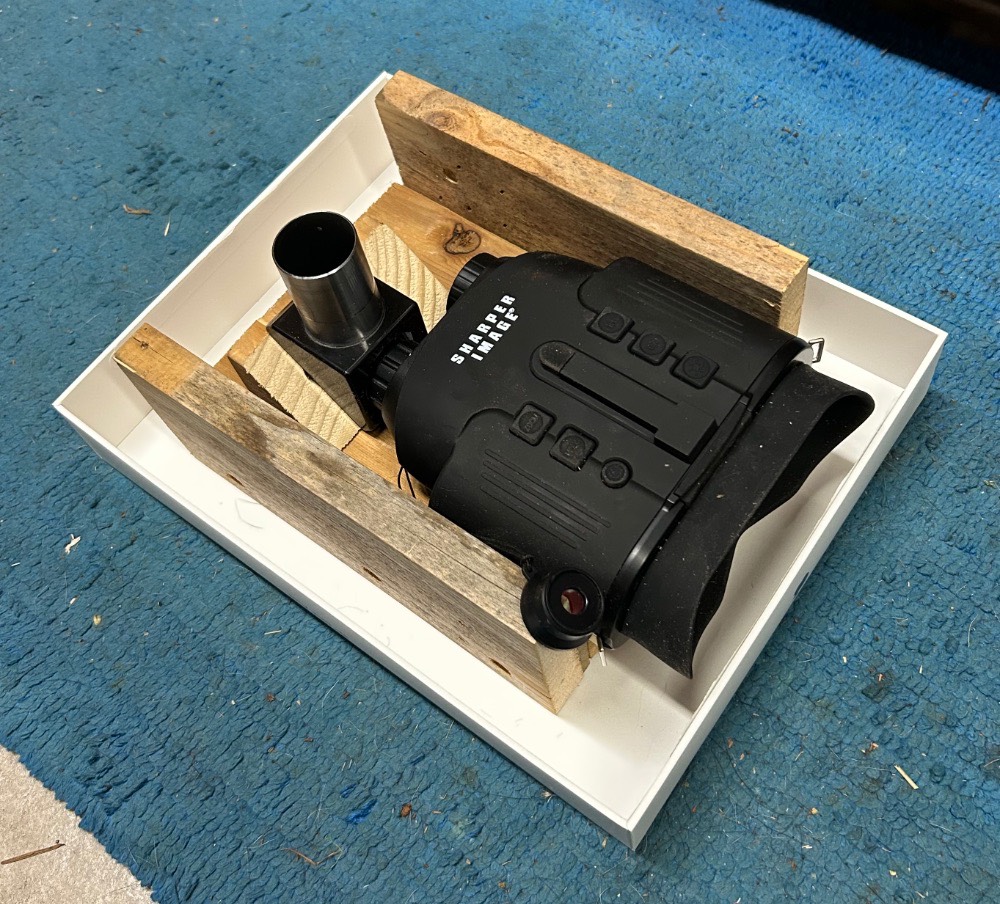
With this new layout, I caught a telescopic meteor in the first half-hour of recording video. I am now rewriting the software that I wrote many years ago to analyze the Leonid meteor outburst in 1999. That requires some major changes, and I am having difficulties getting it operating properly, but I have no doubt that I’ll get it working. In the meantime, though, I need to collect more data, and what I really need is a two-station system. Here’s what a two-station system looks like:

The two cameras will see the meteor at slightly different angles, so if we combine their pictures of the meteor, we might get something like this:
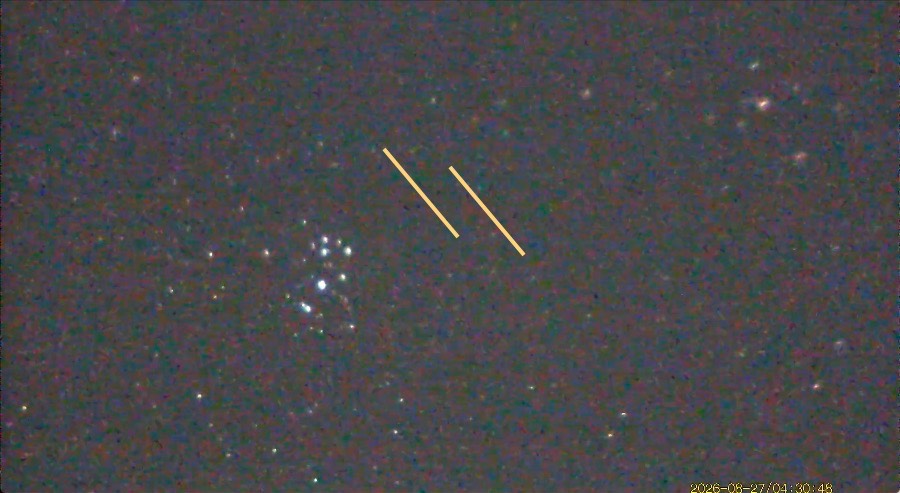
The two meteor tracks are separated, and the amount of separation, combined with what we already know about how far apart the cameras are, allows us to calculate the height and speed of the meteors. That’s important data that is useful when we compile lots of photos like this one.
But in order to make this work, I need TWO camera stations. The first will be at my home. The second should be at an appropriate distance, calculated from what we know of these meteors. Rather than drag you through the mathematics, I’ll simply show you a satellite map of Sterling Creek Road showing areas that are roughly the correct distance from my location and are, I think, accessible by car. I would come to the site as darkness sets in, set up my camera, start it recording, then return home. I would return later to collect the camera and its data.
For this I need a location that is just off the road and has a decent view of the sky overhead. There can be plenty of trees around so long as the sky overhead is visible. It also needs to be private enough that I can leave my camera there without having to worry about somebody stealing it. If you have a spot that you think would be appropriate, I would much appreciate your contacting me at chrisc@erasmatazz.com.
Here’s a map showing the area that seems most likely to be ideal for my work. If you have land in this area and know of a spot where I can do my work in safety and without bothering anybody, I’d greatly appreciate your aid.
Chris